Stratis Health began addressing the opioid crisis in 2014, with a focus on increasing access to evidence-based and culturally relevant care for opioid use disorder (OUD), improving the appropriate prescribing of opioids for pain management, and reducing disparities in care and outcomes.
Why Us
We are subject matter experts on workflows to address the opioid crisis. We provide guidance relating to opioid stewardship and medications for opioid use order (MOUD) practices. Our work to address the opioid crisis focuses on counties, communities, jails, hospitals, and clinics. For hospitals, we leverage a multimodal approach by disseminating education among other areas in health care that commonly serve patients such as surgical services, emergency department, and obstetrics.
American Indian/Alaska Native Healthcare Quality Initiative (AIHQI) a.k.a. Partnership to Advance Tribal Health (PATH) – September 2020-Present
Stratis Health co-leads PATH to provide technical assistance to the nation’s 24 Indian Health Services (IHS) hospitals in seven states. Our team provides training in quality improvement and safety culture and supports the adoption and spread of clinical best practices. This also includes working with the IHS HOPE (Heroin Opioids and Pain Efforts) Committee to implement best practices to promote appropriate and effective pain management, reduce overdose deaths, and improve access to culturally appropriate treatment. Stratis Health serves in national leadership roles providing oversight and coordination of all technical assistance activities. Within PATH, Stratis Health also supports the two IHS hospitals in MN.
Medication-Assisted Treatment (MAT)/Medications for Opioid Use Disorder (MOUD) in Jails
Stratis Health recently completed the DHS-funded “MAT in Jails” project, working with five county jails in Minnesota to offer MOUD to people while they are incarcerated and to support their transition to MOUD care in community clinics. With one of the participating counties, we helped a jail reduce the average time from a person’s jail intake to MOUD treatment referral by 85% (from 38 days to under six days) and the average time from booking to MOUD initiation by 76% (from 49 days to 12 days). Stratis Health recently launched a new MOUD project in county jails, which will run through 2026. This project, funded by the Opioid Epidemic Response Advisory Committee (OERAC), engages 15 county jails and includes a Project ECHO for clinical staff at those jails.
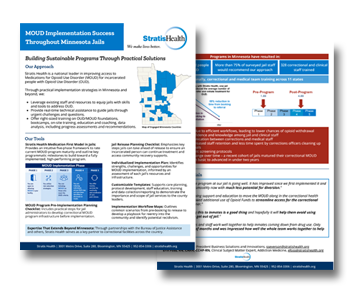
Download the two-page report: MOUD Implementation Success
Throughout Minnesota Jails
Project ECHO – 2018-Present
Stratis Health has a partnership agreement with University of New Mexico Health Sciences Center to serve as a Project ECHO hub. Effective implementation of the Project ECHO case-based learning approach is part of Stratis Health’s interventional strategies in OUD care and treatment. We are also implementing two Project ECHO opioid programs for the Minnesota Department of Human Services (DHS):
- Midwest Tribal Health ECHO, in partnership with NACC (Native American Community Clinic)
- SOAR (Stratis Health Opioid Addiction in Rural) ECHO.
Across both Project ECHOs in 2023, 65 ECHO sessions were held; 3,387 people attended the ECHOs; and 869 CME certificates were requested by attendees. We averaged more than 52 participants per session, and their evaluations were strongly positive, with over 85% saying “the content is useful in my job,” and 91.5% saying “this event was valuable to me.”
Tackling Overdose with Networks (TOWN) Technical Assistance – February 2022-September 2023
TOWN is a clinical care team-based model to prevent opioid overdoses in rural and tribal communities. Working with the TOWN program developers and the Minnesota Department of Health (MDH), Stratis Health took on the lead organizational role for TOWN technical assistance in February 2022. Stratis Health provided educational support, technical assistance to clinic staff, and timely access to clinical subject-matter experts, including addiction medicine physicians, to 12 participating clinics in Minnesota. Engagement included team meetings, site visits, technical assistance for individuals and sites, and bi-monthly nurse peer-to-peer sharing meetings. Over the course of the project, nearly 75% of participating clinics either improved or maintained “optimal” ratings from their first to their final maturity matrix ratings. In August 2023, one of the participating clinics said, “Our two highest prescribers of opioids have both cut their prescribing in half.”
Opioid Prescribing Improvement Program (OPIP) – 2021-2022
Stratis Health recently completed the OPIP for CHS. This project aimed to improve opioid stewardship practices and safer opioid prescribing by Minnesota health care prescribers. Stratis Health’s technical assistance with prescribers improved understanding of their practices and supported tailored feedback on what they could do to improve. It helped identify best practices and issues beyond individual prescribers, which were shared with DHS.
Health Plan Performance Improvement Project (PIP) – 2018-2020
Stratis Health facilitated a Reducing Chronic Opioid Use initiative for Minnesota’s state public program health plans as part of their PIP. This resulted in education and resources on best practices in opioid prescribing, potential alternative therapies when appropriate, and safe drug disposal options.
What we can do for you
We offer the following opioid interactive learning series based on your organization’s needs. Our opioid work is also focused on:
Strengthening organizational capacity: Stratis Health supports strategic planning by building your organization’s capacity to leverage evidence-based approaches to strengthen refills, internal structure and clinic approaches, schedule appointments, leadership strengths, harm reduction, and safety regarding prescribing MOUD.
Redesigning care delivery: We focus on MOUD implementation by providing education for health professionals to access critical data and tools to improve opioid dosing practices. We also offer virtual learning collaboratives to help organizations work with existing staff to integrate MOUD efficiently and effectively in your addiction medicine services. To position people affected by substance use disorder to have a greater chance of being integrated back into their communities, our health care leverages a whole-person health focus in our care transition and care coordination.
Building bridges between health care and community: We work with counties to expand capacity and deliver increased quality health services. We also work to address other substance use disorders relating to other populations that are underserved such as pregnant women and teens.
Contact
Sue Severson
Vice President, Business Solutions and Innovations
952-853-8538